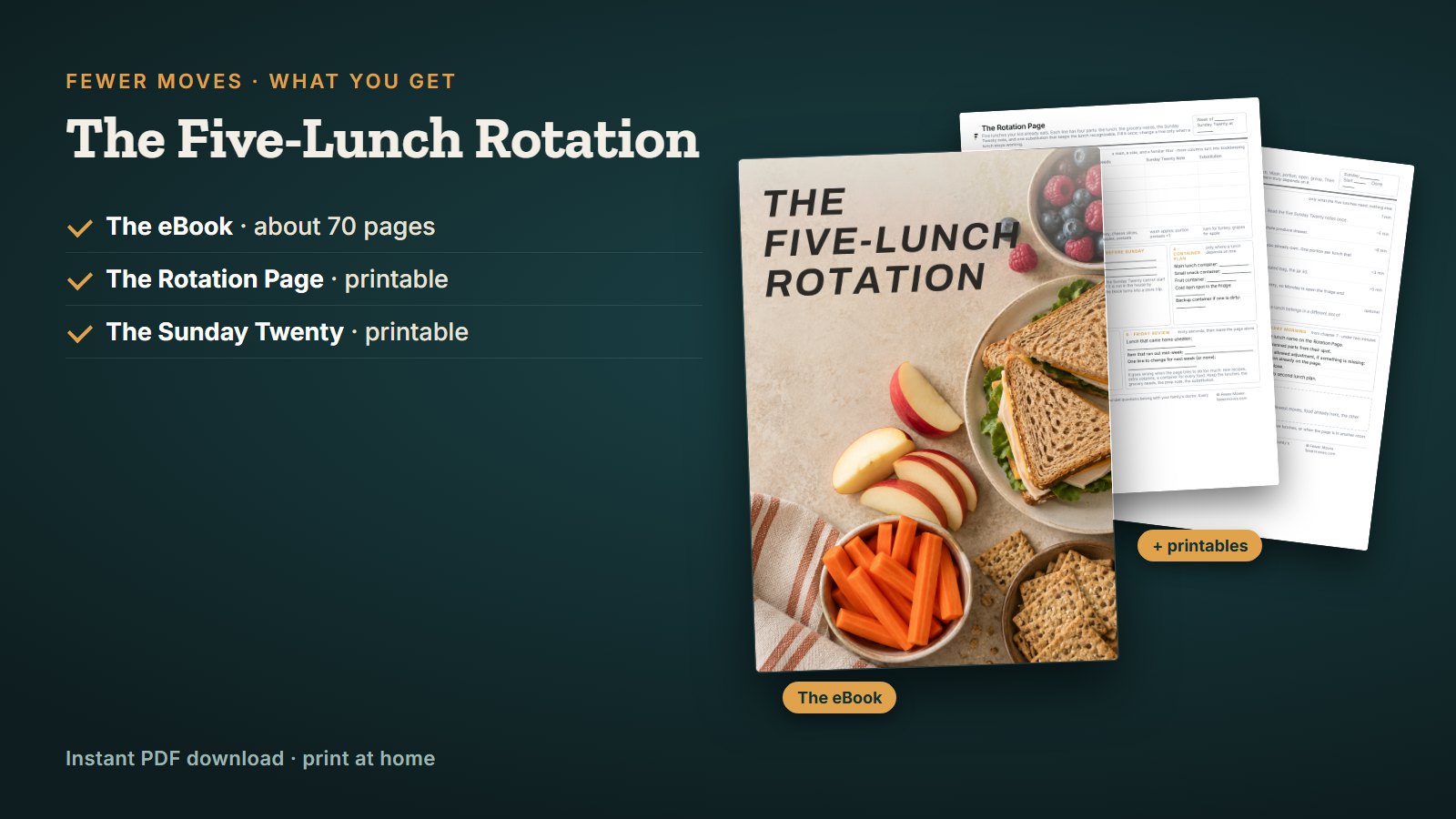
A school lunch is a decision, and you've been making it at 7:12, five times a week, from whatever happens to be in the fridge. The Five-Lunch Rotation puts five repeatable lunches, the grocery list, and the prep notes on one page, and gets the week ready in about twenty minutes on Sunday. No recipes. No new containers. No lunch decided on a weekday morning.
7-day money-back guarantee · Five lunches, one page · Instant PDF download
It's 7:12 on a Tuesday morning. One kid is looking for a shoe, the other is asking what's for lunch, and you are standing at the counter opening the same three cabinets you opened yesterday. You know there's bread. You're not sure there's anything to put on it. So you improvise, again, and the lunchbox goes out the door as a guess. Five mornings a week, the same thirty seconds of panic.
Here's what's actually going on. The refrigerator has food in it. The problem is not lack of food. The problem is that every school morning still asks the same question, what goes in the lunchbox today, and it asks it before coffee, before shoes, before the house has fully woken up. That is two hundred decisions a school year, each one made under a clock. By Friday you have made the same lunch decision five separate times, and the brain keeps paying the same bill over and over.
The lunch isn't the problem. The morning decision is. It was never a food problem. It is a planning problem that keeps pretending to be a kitchen problem.
The question isn't how to be faster at 7:12. It's what lunch looks like when the deciding was already done on Sunday, and Tuesday morning is just opening the fridge and closing the lid.
That's the Five-Lunch Rotation. Five repeatable lunches built from ordinary grocery-store food, the ones your kid already eats. The Rotation Page: one sheet that holds the five lunches, the grocery list, and the prep notes for the whole week. The Sunday Twenty: about twenty minutes of washing, portioning, opening, and grouping, and nothing else. And a substitution rule for the week a lunch gets rejected, so one refusal doesn't put you back at the counter guessing.
One Sunday planning decision and a short packing routine replace five weekday lunch decisions. The weekday version becomes retrieval, not invention.
You pack the lunches. The fridge holds pieces of lunch instead of lunch itself, and by Tuesday every lunchbox goes out the door as a guess.
Sunday afternoon is already claimed by laundry, errands, and dinner. You'd take twenty minutes if it bought you five quiet mornings, but not a second meal-prep shift.
You tried the lunchbox recipe boards and the special containers. They promised organization and delivered another drawer. The morning decision was still yours.
Who it is not for: anyone looking for lunch recipes, a nutrition plan, a full meal-prep Sunday, or a lunch system for a child with allergy or medical diet needs. Those questions belong with your family's doctor. It will not make a child eager to eat every lunch you pack, and it does not tell you what your child should eat. This is a kitchen planning method, not nutrition or medical advice.
The thinking moves to one calm block on Sunday. On a weekday morning the job is to read the page, pull the planned parts, make one allowed adjustment, and pack.
Every candidate food passes a five-question sorting rule before it gets in. Dependable, occasional, or not worth planning around. Recipes and special containers never make the cut.
Five lunches, the grocery needs beside each one, a short prep note in the words you'd say out loud, and one backup per lunch. Nothing lives in your head.
Wash, portion, open, group, then stop. Cooking only stays in when a chosen lunch truly requires it. If a step creates more containers, cleanup, or choices than it removes, it leaves the block.
Keep the pattern, change the piece. The pause rule and the swap-versus-rebuild test keep one refused turkey from turning into five new decisions.
Three questions: what got eaten without a struggle, what created extra work, what should not return. Keep, change, or drop. Never a fresh start.
Most lunch plans don't fail because the food was wrong. They fail because they start from recipes instead of from what your kid already eats, and because the plan lives in three places at once: your head, the refrigerator, and the moment someone asks what's for lunch. Memory can carry that for a while. Then it gets overloaded, and the week starts leaking small mistakes.
So instead of another lunchbox idea, this was built around one question, the same one behind everything Fewer Moves publishes: what is the fewest number of moves that still gets all five lunches done? Five lunches instead of a menu. One page instead of memory. One short Sunday block instead of five weekday scrambles. One written substitution instead of a rebuild at 7:12.
Every decision in the method is there to remove a repeated move, because the repeated moves are what make a small recurring job feel like a side job.
Go through the food your house already buys and run the five-question test: bought regularly, recognized and usually eaten, packable without a recipe, no special container, no new weekday decision. Keep the dependable group. That is your rotation.
Write the five lunch lines first, not the groceries. Add the grocery needs beside each one, a short prep note tied to a physical action, and one substitution per lunch. Put the page where the food is.
Page on the counter. Wash only what the five lunches need. Portion what gets packed. Open only what you'll use. Group each lunch so weekday packing is a grab, not a search. Monday through Friday, read the line, pull the parts, close the lid.
All PDFs. Yours to keep, with every future update included.
For comparison: think about what the morning guess already costs. The pre-packaged lunch kits at four or five dollars each that get bought on the bad weeks. The school lunch you pay for because nothing got packed. The special containers and bento gadgets that promised organization and delivered another drawer. This is $37, once, and it works with the containers you already own.
This is a kitchen planning method, not nutrition or medical advice. It does not tell you what your child should eat. Every food, time, and cost example is an example, not a rule.
Fill the Rotation Page once, run one Sunday Twenty, and pack five mornings without opening the same three cabinets.
If you're still guessing at 7:12, email us within seven days of purchase and you get every cent back. You keep the files. No forms, no reason required.
There's no countdown on this page and no spots left. The honest urgency is this coming Sunday. If the five lunches are on the page before the week starts, Monday morning runs on the page. If they aren't, Tuesday at 7:12 looks exactly like it did last week.
So you have three options. Keep deciding lunch at 7:12, five times a week, from whatever's left. Spend another month collecting lunchbox recipes and gadgets that still leave the morning decision to you. Or take the Five-Lunch Rotation, for $37, and make the decision once, on Sunday.
Here's the challenge. This Sunday, write five lunches your kid already eats on one page. Spend twenty minutes washing, portioning, and grouping them. Then pack Monday through Friday without deciding anything. If the lunchbox goes out the door five mornings in a row without a guess, you already know what the rest of the school year looks like.
Five lunches. One page. This Sunday.
No. The rotation is built from the foods your house already buys and your child already eats. The book handles the planning side and the assembly side. What goes in the lunch is your call, and anything about allergies or a child's diet belongs with your family's doctor.
No. The lunches are combinations, not recipes: a main, a side, a filler, from ordinary grocery-store food. The Sunday Twenty is about twenty minutes of washing, portioning, opening, and grouping. The container plan uses what you already own, and no lunch is allowed to depend on one exact box.
That is what Chapter 5 is for. The page carries one written substitution per lunch, so a refusal costs one swap, not five new decisions. Keep the pattern, change the piece. A rebuild is only for a pattern that genuinely isn't working.
No. It is a kitchen planning method, not nutrition or medical advice. It does not tell you what your child should eat, and it makes no claim about your child's health. Every food, time, and cost example in it is an example, not a rule.
You have seven days. Email us, get a full refund, and keep the files.
No. It is an eBook of about 70 pages, seven short chapters, plus two printable pages, the Rotation Page and the Sunday Twenty card, all PDFs you download the moment you buy. Read it in about an hour, fill the page in one sitting on Sunday.
No. The five lunches are combinations of ordinary grocery-store food your kid already eats, not recipes. The Sunday Twenty is about twenty minutes, not an afternoon. The container plan is built from what you already own.
A short prep block, about twenty minutes, that prepares only the parts the five lunches need. Put the Rotation Page on the counter, wash only the produce the lunches need, portion what gets packed, open only the packages you'll use, and group each lunch so weekday packing is a grab. Cook only when a chosen lunch truly requires it.
You use the substitution already written beside that lunch on the Rotation Page. The rule is keep the pattern, change the piece: swap the protein, the fruit, or the bread, not the whole lunch. The other four lunches stay untouched. Allergy and diet substitutions belong with your family's doctor.
Use it for seven days. Fill the Rotation Page once, run one Sunday Twenty, and pack five mornings without opening the same three cabinets. If you're still guessing at 7:12, email us for a full refund. You keep the files.